
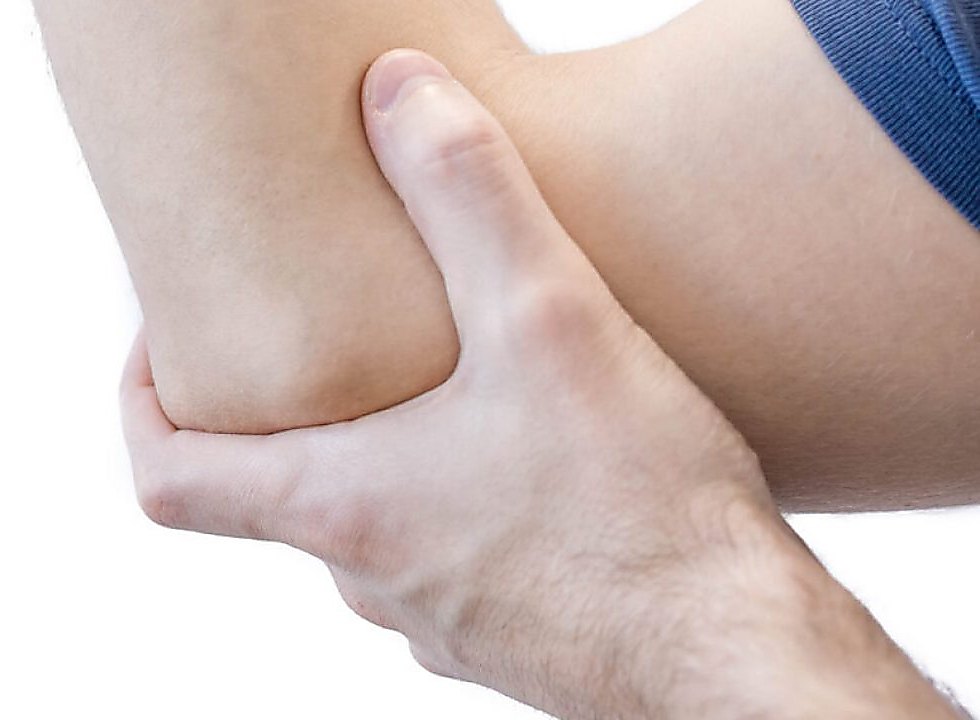
Cubital tunnel syndrome arises when the ulnar nerve is compressed within the cubital tunnel on the inner (medial) side of the elbow.
Overview
The ulnar nerve supplies sensation to the little finger and part of the ring finger and innervates most of the small muscles of the hand.
Although most cases have no evident cause, the tunnel may also be narrowed by arthritis of the elbow joint or by previous trauma.
Symptoms
The first symptoms are usually numbness or tingling in the ring and little fingers. These are often intermittent at first and may become constant as the condition progresses.
The symptoms may be provoked by:
- leaning on the elbow;
- keeping the elbow bent for long periods — while talking on the phone, for example;
- sleeping with the elbow bent.
At more advanced stages, the numbness becomes constant and hand strength diminishes. In severe cases there may be visible muscle wasting in addition to loss of strength and dexterity.
Diagnosis
Radiographs of the elbow and nerve conduction studies may be used to establish the diagnosis.
Treatment
Whenever possible, activities that provoke the symptoms should be avoided or modified, for example by:
- using a headset when talking on the phone, so that the elbow does not need to be bent;
- padding the elbow or wearing a splint at night to limit excessive bending.
Such measures may be curative in early cases.
In severe cases, or when nonsurgical treatment has not produced a response, surgery is required to relieve pressure on the nerve. Although surgery is often performed to relieve numbness, its principal purpose is to prevent progressive muscle weakness and wasting.
- Decompression
- The roof of the cubital tunnel is divided, relieving pressure on the nerve.
- Transposition
- The nerve is moved to a new position in front of the elbow (anterior transposition).
Response to Treatment
The response to treatment depends on the degree of nerve compression. In almost all mild and moderate cases, the symptoms resolve completely.
Surgery halts the progression of weakness; however, recovery of muscle strength is usually slow.