
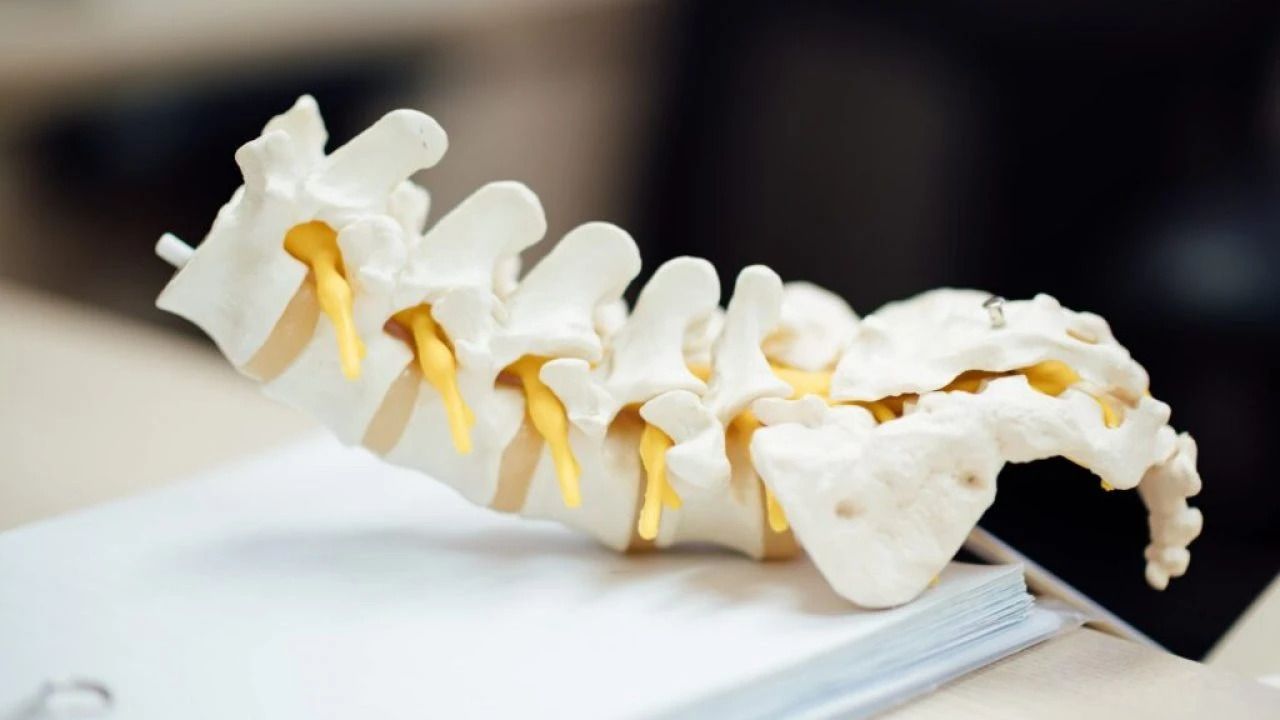
Lumbar disc herniation occurs when the tough outer layer of the disc deteriorates and its inner part protrudes, compressing the spinal cord and/or the nerve roots arising from it. It is among the commonest causes of back and leg pain.
The Discs and Their Function
The lumbar intervertebral discs lie between the bones of the spine. Their functions are:
- to permit movement and flexibility of the spine;
- to connect the bones of the spine to one another;
- to protect the spine against injury;
- to distribute load evenly across the spine.
An intervertebral disc consists of two layers: the nucleus pulposus within and the annulus fibrosus without. Deterioration of the tough outer layer for any of several reasons, with consequent protrusion of the inner part and compression of the nervous structures, is what is termed disc herniation.
Symptoms
A patient may have only one of the following, or several, or all of them together.
- leg pain — also termed sciatica or radiculopathy;
- back pain;
- numbness and tingling in the leg;
- weakness of the leg or foot.
Diagnosis
A complete physical and neurological examination together with an assessment of the patient history is essential to the diagnosis. Imaging — plain radiographs, MRI and CT — may be used in addition.
In certain cases a test known as electromyography (EMG) is performed in order to assess nerve function.
Treatment
The great majority of patients recover without surgery, on conservative treatment. Such treatment includes:
- rest;
- anti-inflammatory medication;
- corticosteroids;
- epidural injections;
- physiotherapy.
An operation may be required where these measures fail, where the symptoms worsen, or where weakness develops. The purpose of surgery is to remove the herniated disc and so relieve the pressure on the spinal cord and nerve root.
Surgical Procedures
- Lumbar Microdiscectomy
- The commonest operation for lumbar disc herniation. A small incision is made over the affected level and the herniated portion of the disc compressing the nerve is removed.
- Endoscopic Lumbar Disc Surgery
- A fully closed technique, applicable in suitable cases.