
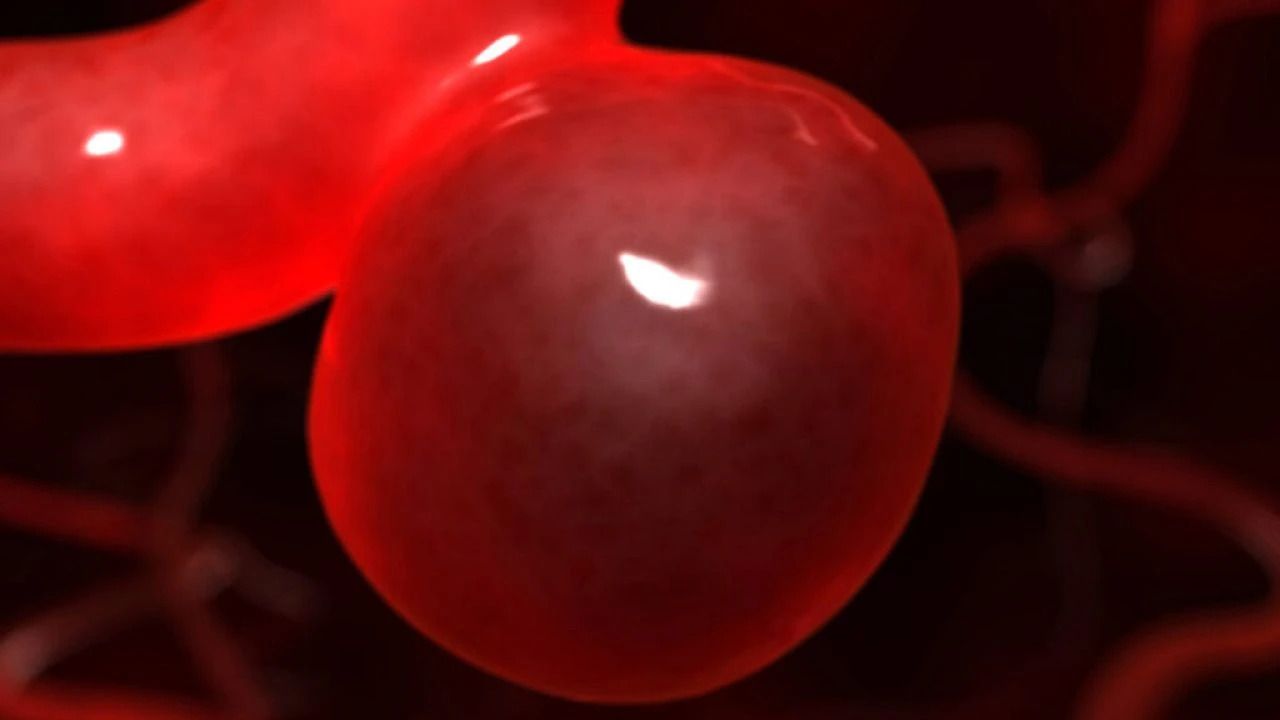
A brain aneurysm, also termed a cerebral aneurysm, is a balloon-like swelling at a weak point in a cerebral artery.
Overview
Cerebral aneurysms may rupture and cause bleeding within the head (subarachnoid hemorrhage). Subarachnoid hemorrhage is a life-threatening condition.
Even where it does not bleed, a cerebral aneurysm may give rise to symptoms by pressing upon the cranial nerves or upon brain tissue. Most cerebral aneurysms arise from the ring of interconnected arteries at the base of the skull known as the circle of Willis.
Subarachnoid hemorrhage may lead to complications such as hydrocephalus and vasospasm, as well as to a range of systemic complications.
Symptoms
Cerebral aneurysms usually produce no symptoms until they reach a certain size or until they rupture and bleed. An aneurysm, whether or not it has bled, may give rise to one or more of the following:
- sudden, severe headache;
- pain above and behind the eye;
- double vision;
- drooping of the eyelid;
- nausea;
- vomiting;
- disturbance of vision;
- numbness, weakness or paralysis of one side of the face;
- neck pain or stiffness;
- sensitivity to light;
- loss of consciousness;
- seizures.
Treatment
The decision to treat takes account of many factors: the site, type and size of the aneurysm, the risk of bleeding, and the age and comorbidities of the patient. In accordance with international guidelines, some aneurysms may be observed without treatment. Where treatment is indicated, surgical and endovascular methods are applied with good results.
- Microsurgical Clipping
- Using microsurgical technique, a clip is placed across the neck of the aneurysm while the parent vessels are preserved, so that blood no longer enters the aneurysm.
- Endovascular Embolization
- A catheter is introduced through the groin and the aneurysm is packed with coils. In addition or as an alternative to this, a flow-diverting stent may where necessary be placed in the artery bearing the aneurysm.