
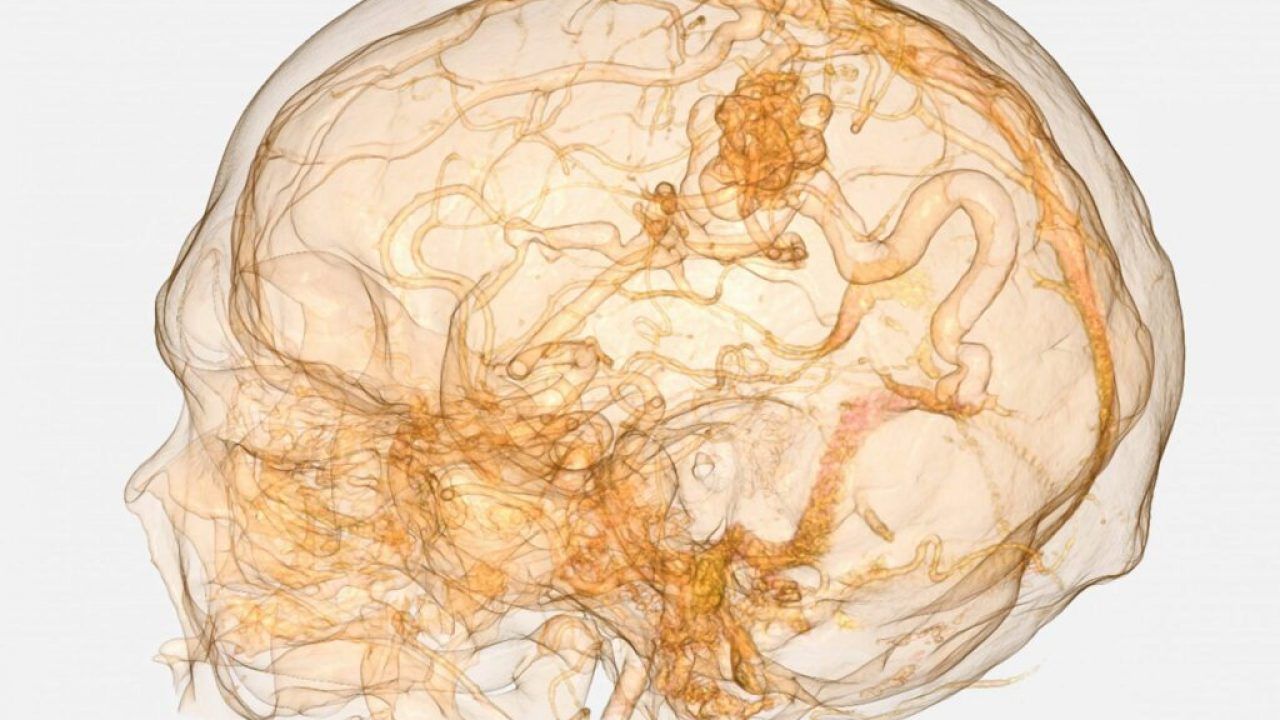
An arteriovenous malformation is an abnormal tangle of vessels within the tissue of the brain or the spinal cord.
Overview
Such a malformation may arise anywhere in the central nervous system. It causes blood to pass directly from the arteries into the veins without traversing the capillary bed.
An arteriovenous malformation may damage the brain or spinal cord in three ways:
- The arteries and veins within the malformation may rupture and cause bleeding (hemorrhage).
- The supply of oxygen to the adjacent brain and spinal cord tissue is reduced, impairing normal function and giving rise to seizures or neurological deficits.
- The malformation may press upon the neighboring tissue and so cause neurological loss.
Symptoms
The symptoms vary with the site and size of the malformation and with whether or not it has bled; there may be no symptoms at all. They resemble the findings of a number of other conditions.
- headache;
- seizures;
- loss of strength;
- disturbance of balance and coordination;
- dizziness;
- loss of part of the visual field;
- difficulty with speech and comprehension;
- memory loss.
Treatment
Treatment depends upon the size and location of the malformation and upon the symptoms it produces. One or more of the following may be recommended.
- Surgery
- Suitable malformations may be excised by microsurgical technique, the healthy brain tissue and the normal vessels being preserved. Surgery is not recommended for high-grade malformations.
- Endovascular Embolization
- The malformation is occluded by way of the blood vessels; this is generally used in preparation for surgery. It is rarely applied as a treatment in its own right.
- Radiosurgery
- Over the past twenty years Gamma Knife radiosurgery has come to the fore in the treatment of arteriovenous malformations. It carries less risk than the other methods. Approximately three years must pass, however, before the malformation disappears after radiosurgery, and the risk of bleeding persists throughout that period.