
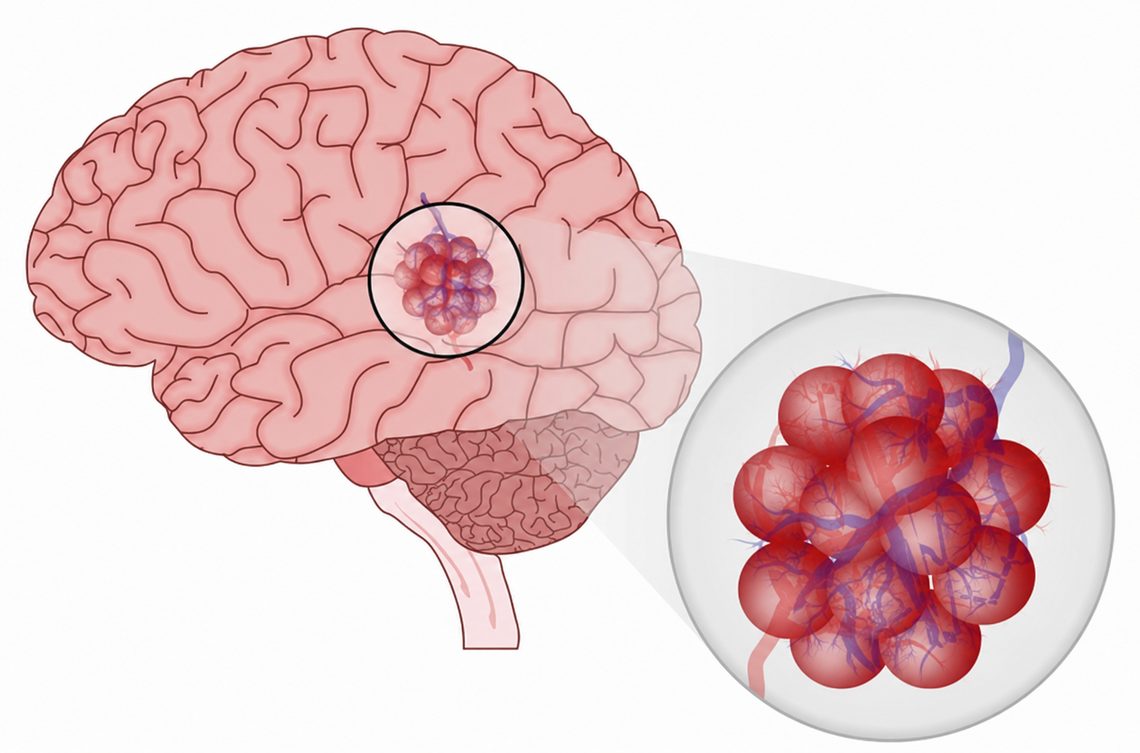
A cavernous malformation is a cluster of dilated and irregular blood vessels (capillaries).
Overview
The walls of these capillaries are thinner than normal and the junctions between their cells are loose, so that they are prone to bleed by seepage.
A malformation of this kind may arise anywhere in the body. Cerebral cavernous malformations may give rise to neurological symptoms when they bleed (hemorrhage).
Symptoms
A cavernous malformation may produce the following:
- headache;
- seizures;
- memory loss;
- unsteadiness;
- disturbance of speech;
- impairment of hearing and/or vision;
- weakness or numbness.
In most patients the neurological deficits that follow a hemorrhage improve considerably over time. Repeated hemorrhage, however, may leave permanent deficits.
Observation and Treatment
Cavernous malformations that have been diagnosed but are causing no symptoms may be followed up with regular MRI scans. Antiepileptic medication is among the treatment options where seizures require control.
Symptomatic cavernomas that give rise to repeated hemorrhage must be treated. Two methods are used.
- Surgical Excision
- Removal of the malformation by microsurgical technique.
- Gamma Knife Radiosurgery
- Treatment of the malformation with radiation focused on the target region.